Tuesday, May 17, 2016

I'm Oil Pulling?

So I've decided to try out a natural oral care regiment starting with oil pulling. I plan to add other natural oral care techniques to my routine but one at a time. My hope is to share with you all how it goes for me so you can get a first hand look that isn't selling anything - most of the post I've seen talking about oil pulling are from companies or people who have been doing this for years. I'm just starting and if you are thinking of starting or curious about what its like, here you go:

What is Oil Pulling?

Oil Pulling is the act of swishing oil in your mouth, between your teeth, for a certain amount of time (usually recommended about 20 minutes) in order to detox the mouth and the body.
Why does this work?
The mouth is both one of the biggest places we take in toxins (through food, drink, air, etc) and one of our biggest places of detox. In the morning, many of us have a bad taste in the mouth, a filmy feeling, or even just junk on our tongue. This is all signs of detox from a night of fasting while we sleep. One of the worst things you can do is get a big swig of water because that would just wash all those toxins back into the body.
Oil pulling does what the name says, you pull the oil between your teeth and along your gums and it pulls the toxins into itself so that when you spit, the toxins go out, not in.

*Benefits of Oil Pulling

Whitens teeth
Improves breath
Soothes bleeding gums
Believed to reduce inflammation.
Shown improvement in acne, Keratosis Pilaris, Psoriasis and Eczema.
TMJ sufferers have reported less jaw pain from oil pulling.
In some studies, oil pulling reduces Streptococcus Mutans bacteria, a significant contributor to tooth decay.

Which Oil Do I Use?

I use coconut oil.
Coconut Oil contains ealthy fats called medium-chain fatty acids (MCFAs), these unique fats include:

  • Caprylic acid
  • Lauric acid
  • Capric acid

91% of the fat in coconut oil is healthy saturated fat.
Unlike long-chain fatty acids (LCFAs) found in plant based oils, MCFAs are:

  • Easier to digest
  • Not readily stored as fat
  • Are anti-microbial and anti-fungal
  • Smaller in size, allowing easier cell permeability for immediate energy
  • Processed by the liver, which means that they are immediately converted to energy instead of being stored as fat

Benefits of coconut oil include:

  • Reduces Inflammation and Arthritis
  • Cancer Prevention and Treatment (because of the ketones produced in it’s digestion. Tumor cells are not able to access the energy in ketones and are glucose dependent)
  • Immune System Boost (antibacterial, anti-fungal, and anti-viral)
  • Improves Digestion (helps the body to absorb fat-soluble vitamins, calcium, and magnesium)
  • Improves Skin Issues (burns, eczema, dandruff, dermatitis, and psoriasis)
  • Prevents Osteoporosis (high levels of antioxidants which help fight free radicals)
  • Candida and Yeast Infections (because of the capric acid and lauric acid in coconut oil)


How did I start?

My normal morning routine, not counting the diaper changes, nursing, and other baby care, was a quick brush with Toms of Maine fluoride free toothpaste and a cup of coffee. Not the healthiest but at least I'm brushing.
This morning I got up, did the baby stuff, and then put a small spoonful of coconut oil in my mouth.
I will admit now - this is not the most pleasant experience I've ever had. The coconut feels weird and waxy in my mouth until it melts. Once it melted, I swished it between my teeth.
The recommended amount of time is 20 minutes. It's really hard, btw, to swish 20 minutes. My jaw was getting sore after a minute (I do have TMJ). I only lasted a lil under 5 minutes. Like exercise, its good to build up your time, I'm told.
After pulling, I brushed my teeth. My gums felt soothed, my teeth felt cleaner than when I just brushed. It was really nice. I then made my cup of coffee...I know, I know, one thing at a time.

Have you tried oil pulling? What oil did you use - I know there are oil pulling sets you can get with little pre-packaged oils and all but I've not invested in this yet. How did it go for you? I could use some stories of encouragement.
An article on Oil Pulling I liked by Dr. Axe. You can find info on Oil Pulling everywhere though - Pinterest, TV, billboards, everywhere!

*These statements have not been approved by the FDA. Please see your doctor, dentist, etc for your oral care.

Saturday, May 14, 2016

Crochet Carry Case for Your Essential Oils

We now have a crochet pattern for an essential oils carry case on our Etsy shop!
I came up with this pattern after purchasing some oils and thinking about how it would be nice to carry a few with us when we go to events and the like but I didn't want them rolling around in our bags. There are carry cases out that you can buy but I just needed something small to stick a few into. The more I thought about it the more I knew I could make my own - just had to decide if I wanted to sew one or crochet one. I have been meaning to get through some of my stash so crochet it was!


I'm a particular fan of green - as I'm sure most of you can tell on this site. 

Friday, May 13, 2016

Splurging on Spruce Tips

We tried spruce tips for the first time ever the other day. I have been eyeballing the trees in our yard for some time now, waiting like a kid shaking presents leading up to Christmas. Finally, they were ready!

Usnea
I picked a cup full while harvesting Usnea off some dead tree limbs (will post about Usnea later).
I wasn't sure how I wanted to try them at first. Tea, bake them into a cookie, candied...so many ideas from reading about them online.

Damon made the decision for me as he put six freshly caught trout onto the grill.

We love trout salad here.
We started eating trout salad when we first moved to Alaska and were half feeding ourselves just from fish we caught and wild edibles we foraged for. It was actually a really fun and happy time in our lives and we always feel nostalgic now when we eat trout.

With trout salad coming up, I garbled (to pick clean the foraged goods) the spruce tips and put them in a bowl with apple cider vinegar.

Spruce Tips and Trout Salad
Trout Salad Recipe

Grill your trout skin on. Once cooked through, let cool and then pick the meat off the bone. This is a messy, tedious process but worth it.
With a bowl of trout meat, add:
1 onion, finely chopped
1-2 large ribs of celery
Mayo to taste
To this I added the spruce tips (removed form the vinegar) chopped lightly.
Serve on a favorite cracker or in a lettuce wrap

My family was a little skeptical of the spruce tip addition to the meal but after a first, hesitant, taste - They Love It! In fact, a few people didn't get to the bowl in time after their first taste - all gone in moments it seems.
I've also added these vinegar spruce tips to carrot and cabbage salad. Soon I'll be giving spruce tip shortbread a shot too!

Why do Spruce Tips Rock?

Besides the yummy flavor that is a lil minty, a lil bitter, a lil medicinal - sounds weird but it is good.
Spruce needles are exceptionally high in Vitamin C, contain carotenoids, rich in minerals such as potassium and magnesium, and they contain plenty of chlorophyll. Native Alaskans often used the dried and preserved tips in tea to prevent scurvy in the winter months as well as to treat symptoms of colds and flu.
These benefits can also be found in other conifer tips, I'm told.

Harvested Spruce Tips
Harvesting Spruce Tips

Look for bright green tips on the end of branches in late spring. These might have a brown, papery casing on the end. When this casing comes off easily, they're ready to be picked. Don't force the casing. If the casing is already off, they can still be picked. However, if the green tip is already spreading out and hardening, they're still edible but not as strong or as pleasant.

Picking them should be a sticky, strong smelling process - one I personally enjoy.
My 7 month old baby boy smelled my hands when I came in from picking and made the funniest face but grinned as if he understood.
Garble them soon then, if you want to preserve do so while fresh so that you can keep the oils intact.

Monday, May 9, 2016

Getting Grounded: The Healing Benefits of Earthing

Go barefoot. Get your feet on the ground, in the grass, in the dirt. Run your toes in the sand, get soil on your heels. Heal yourself from the ground up, literally.


Earthing: (ərTH-ing) verb
1. connecting with Mother Earth through the intimate, grounding connection of bare feet to the Earth's skin.
2. Renewing the electrical connection between humans and the earth.

We here at Terrestrials believe there is an intimate, necessary, beautiful connection between us humans and our home - Earth. Its where we got our name - Terrestrials, those of the Earth.
A few years back, we read the book Earthing: The Most Important Heath Discovery Ever! and it resonated with truths we already guessed at but didn't yet have the scientific backing for. In short, the book explained that many dis-eases that we humans suffer today are due to a disconnect we've created with the Earth.

Disconnected

Think of the last time you had your bare feet touching the earth.
Many of us go days, weeks, even months or years with minimal Earth contact.
We've separated ourselves from the Earth with concrete blocks, asphalt, and rubber soles. We insulate ourselves in buildings and in clothes to keep us from ever being effected by the Earth. This, in concept was a great idea - we won't be bothered by the elements this way. However, we didn't notice the ill-effects until, for many of us, it was too late.

We are electrical beings. Our brains, muscle function, nerve endings - all run on electricity generated by our bodies.
We live in an electrical universe. Our world and its interaction with the planets, moons, and suns of our galaxy are all aligned by electro-magnetic fields. (see: The Electric Universe)
In this world of electricity as electric beings, we need to be grounded.
Appliances, when plugged in and working but not grounded, have the potential to shock anyone around them, overload, catch fire, and more. Now, apply this concept to humans.
When we aren't grounded, we overload, become inflamed (inflammatory illnesses like arthritis and fribromyalgia have been noticeably effected by grounding), are over-stressed, and can, because of this, hurt ourselves and those around us (shocking).


Get Back to the Dirt

One of the first things our midwives told us to do to keep our babies healthy in our post-birth class is to get our babies outside and touching dirt. This might sound completely insane in our world of anti-germs and sterilization but our current society is showing that a germ-free world does not equate to a healthy world.

We have seen the benefits of getting our son outside firsthand. Our little boy is teething and has his cranky days just like anyone else. We've found that if, when he's cranky, we take him outside and let him breathe the fresh air, touch the earth and the trees, his mood rapidly changes. In moments he goes from crying, in pain, and cranky to calm, smiling, and completely soothed.
As for the health benefits, we've noticed the difference in some of our family. My aunt has 2 children. The first she followed the mainstream concept of keeping things as sterile as possible. This child is one that is constantly sick either with a cold, allergies, ear ache, etc. The 2nd child she changed methods and allowed for a lot more outdoor play without stressing over being so germ-free. While this child has had a few cases of belly aches and a cold, the difference in health is remarkable. (Note: both children were raised similarly in every other way from formula fed to diapers so that was not a contributing factor in differences).

When we look at our ancestors - those beloved people who lived into their 90's and even to be 100 or 110, we often see a common link to their long, healthy lives. Many of them spent time connected to the earth. They gardened, farmed, spent time outside regularly.
One of the oldest and healthiest people we know is Damon's grandmother. A woman in her 80's who's only health problems are aching knees and anxiety brought on by past family problems. She is lively and sound of mind. How does she keep up such good health? She gardens. As soon as its warm enough outside to get into the green house, her hands are in soil. As soon as the ground thaws, shes outside, on her knees, digging.
Its not hard to see the connection.

With the warm late spring weather we're having, I cannot recommend more to getting outside, getting barefoot, and getting grounded!

*Affiliate links are used in this blog post. This means that if you purchase a book through our Amazon affiliate link, we get a small commission. You do not pay extra by using this link. The use of this link in no way effected our recommendation or use of this product. 

Sunday, May 1, 2016

Labrador Tea


 All around our propert grows this evergreen vine-like shrub that I kept being drawn too while we were walking around, taking in the spring sunshine and fresh air. I flashed a few pics of it with my phone, took it to a group of fellow wild-herb enthusiasts and confirmed my suspicions...

My Herb Journal Notes

Ledum groenlandicum 
L.palustre
L. glandulosum aka Trappers Tea - white underneath
L. latifolium
Common name: marsh tea
Also considered part of the Rhododendron family so you will often see these scientific names as R. groenlandicum, etc. instead.

Tonic, diaphoretic, and pectoral. Also considered a narcotic.
Was used by natives as a medicine. European settlers used it as a beverage to replace tea, a tradition taken up by natives during the time of settlers.
Blood purifier, treat rheumatism, combat cold symptoms, yteat stomach ailments, hangovers, dizziness, pulminory disorders including tuberculosis. A wash soothes rashes, poison ivy, sores, burns, leprosy.
Marinade for strong meats and tannins used to tan hides. Has ben used in beer making.
Use as a wash against lice and other insects.

In a study published in the Journal of Ethnopharmacology in 1992, Dr. Allison McCutcheon and colleagues found the branches of Labrador tea act as an antibiotic against E. coli and Bacillus subtilis. Previous studies demonstrated the floweringheads in an extract were effective against both bacteria as well as the yeast Candida albicans. Other researchers also found extracts from the leaves active against Staphylococcus aureus bacterium.  ~Beverly Gray


Toxicity

I had to ask, when I first started looking into Labrador tea - Is it really toxic? Can we really base these decisions on the poisoning of stock animls who have ingested entire stands of it? Bases is on Ledol or ledum camphor, much like suspicions of comfrey being toxic being based on studies on lab rats.
So I did my reading and what I learned is yes BUT L. groenlandicum is supposed to be safe in a small dose as it has the least amount of ledol and its tisane often drunk for its medicinal use. I would not drink more than 1-2 cups a day though, if you decide to drink often and do not brew longer than 5-10 minutes.

Look-a-likes - bog rosemary, bog laurel, as well as other types of Labrador, all of which are considered toxic but do not have that rust looking fuzz underneath.

Harvest and Brew

Best harvested in spring when bright green but available to harvest year round - choose wooly, fragrant leaves
Leaves oft retain color, shape and flex even when dried. Store whole.
Blend in tea with rosehips, wood sorrels, licorice fern, anise hyssop, wild ginger, mint, citrus fruit peel, or chai herb mix may be used for flavor. Can also be cut with black tea.
Steam crushed hern up to 10 minutes


I will keep you all updated on how this tea works out for me.
Green Blessings
December

Friday, November 13, 2015

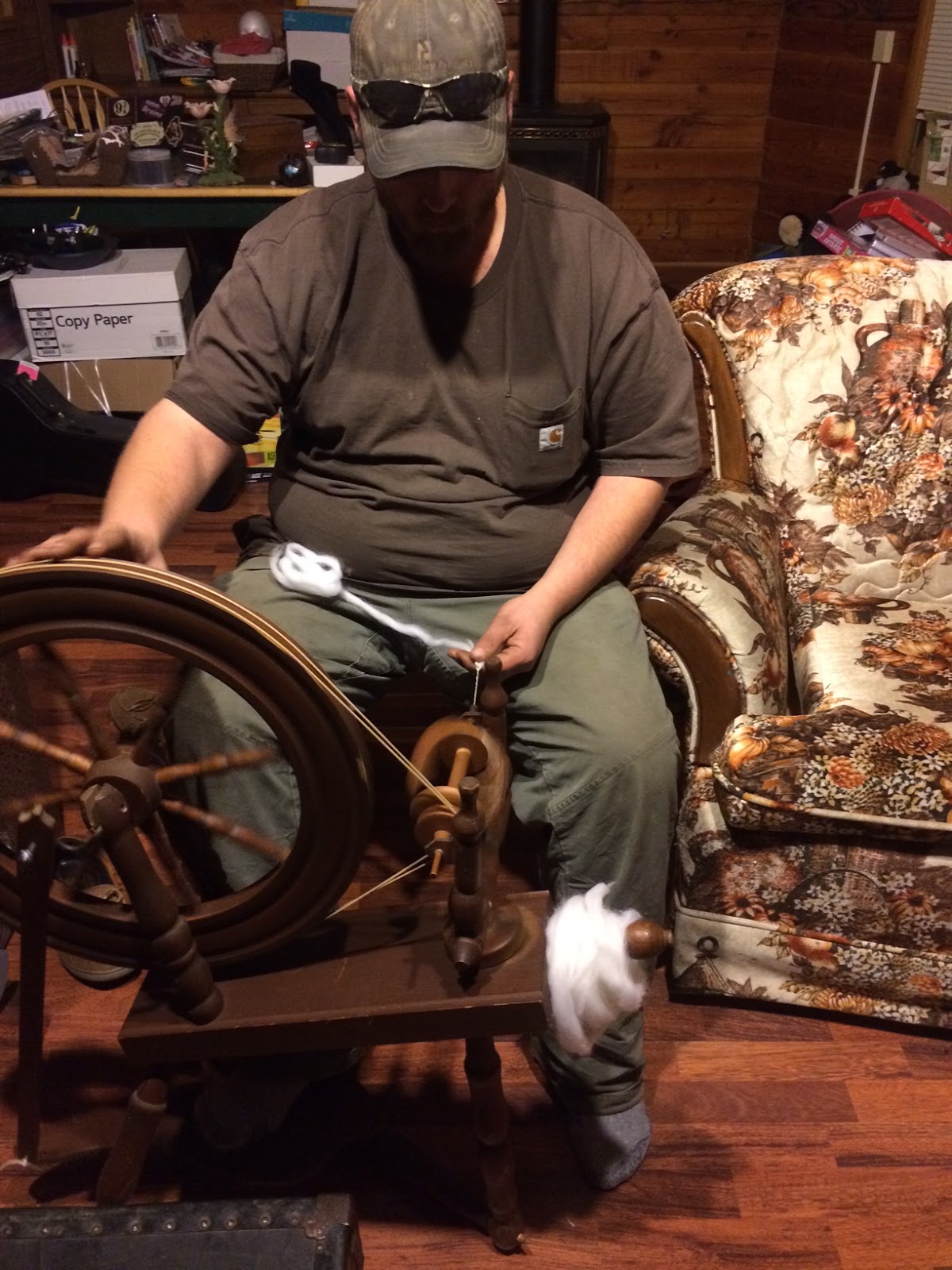
Spinning

Damon calibrating our spinning wheel


Option 2...

Birch drop spindles